
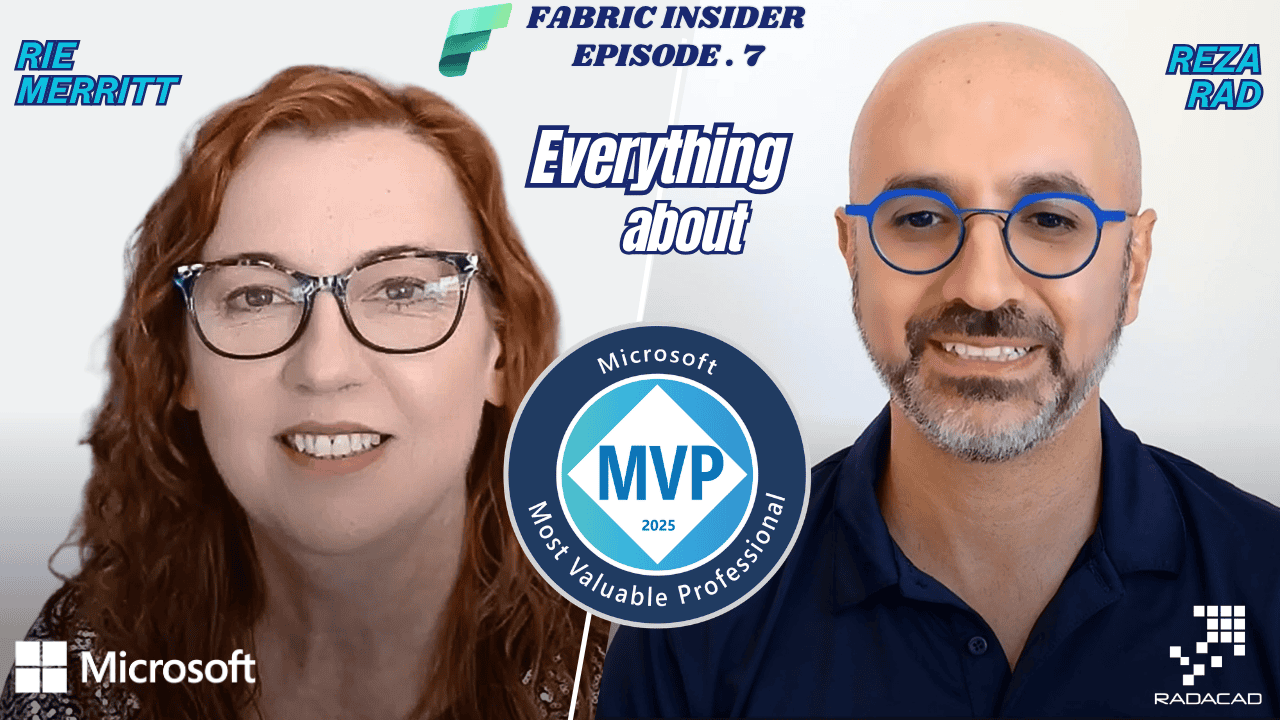
This episode of Fabric Insider is a little different from the others. We are not talking about a product feature or a technical update. We are talking about a program that has shaped the Microsoft data community for over two decades — and one that a lot of people misunderstand.
The Microsoft MVP program is one of those things where everyone in the data community has heard of it, many aspire to it, and very few actually understand how it works from the inside. What makes someone an MVP? Is it about having a big social following? Do you need certifications? Can introverts qualify? Is there a cap per region? And what does the process actually look like from the person who reviews every single profile?
I sat down with Rie Merritt — Principal PM Manager and MVP Lead at Microsoft — to answer all of those questions. Rie has been on both sides of the program. She was an MVP herself before joining Microsoft. And for the past six and a half years, she has been the person who runs the data platform MVP program, reviews every nomination, makes every award decision, and leads the engineering side of FabCon and SQL Con.
Fabric Insider Series | Episode 7 | Interview with Rie Merritt, Principal PM Manager, MVP Lead at Microsoft
📺 Watch the full episode on YouTube: Fabric Insider Ep. 7 — Everything About the Microsoft MVP Program | Rie Merritt
🎧 Listen on Spotify: Fabric Insider Podcast
📚 Full Fabric Insider Blog Series: radacad.com/category/fabric-insider-2026
🎬 Full Fabric Insider Playlist: YouTube Playlist
🔗 Rie Merritt on LinkedIn: linkedin.com/in/rie-merritt
Who Is Rie Merritt? (Video: 0:00)
Reza: Before we talk about the MVP program, which is the subject of this talk — would you mind introducing yourself, who you are, what part of the program you are dealing with, and what other things you might do?
Rie: So like you said, my name is Rie Merritt. I’m a Principal PM Manager with Microsoft and I run what we affectionately call the Influencers, Events, and Community team. What falls under my purview are MVPs and RDs. We have two user group networks — one that supports the SQL and databases community and one that supports all things Fabric. We have a Super Users program — the people who answer forum questions for you on the Fabric community platform. They are experts in Fabric, Power BI, RTI, data integration. And then the biggest thing on my plate right now is running the engineering side of FabCon and SQL Con. We have one coming up in late September, early October in Barcelona, Spain. And there is also a new one announced — FabCon AP Pack — starting small in Sydney, mid-April 2027.
Reza: That is so many things you are doing, which is amazing. Now talking about the MVP program itself — I get this question a lot from people who are not in the program. Those who are in it have a good understanding, but those who do not — if you want to define it, what is an MVP and what is this program?
What Is a Microsoft MVP? (Video: 2:26)
Rie: A lot of people don’t know what an MVP is, and that’s fine. I even have Microsoft employees who don’t know exactly what an MVP is. So the question I get most frequently is: are MVPs Microsoft employees? No, they are not. In fact, you cannot be a Microsoft employee and be an MVP. MVPs are technical experts on various Microsoft products who use that knowledge in a way that they share it with others. It is not just that you can be the smartest technical person in the world — you won’t qualify to be an MVP if you don’t share that knowledge in some way.
Do you deliver sessions at user groups? Do you deliver sessions at conferences? Do you organise? Do you blog? Have you written books? Do you answer questions on forums? Do you run a YouTube channel? Do you live stream? Do any of these things — and for what I specifically care about, anything that falls under Azure data. There are about 4,000 MVPs globally at any given time across around 19 or 20 different award categories. I specifically run the data platform award category.
Reza: So MVPs are not Microsoft employees — in fact, as soon as someone becomes a Microsoft employee they lose their MVP status. They do these community activities that you mentioned. Now there is also a misconception that anyone acting like an influencer should become an MVP. Like if you go and build funny videos about something, if you are influencing people, you should become an MVP. Can you talk a little bit about the technical aspect — how important is that?
MVP vs. Influencer — What Is the Difference? (Video: 4:42)
Rie: There is what an MVP is and what an influencer is. There is a little bit of a Venn diagram. There are MVPs out there who are influencers in that they have a large following on LinkedIn, a large following on YouTube, on different social media when they share information. And so are they influencers? Yes. But when you think of just an influencer in the classic sense, MVPs probably don’t fit that exact definition — because a lot of influencers will also do ads for things or whatever else.
There are plenty of MVPs who don’t want that kind of life or spotlight. They are just out there on a regular basis speaking at user groups — whether local or virtual — they organise a user group, they speak at conferences in their community, and they consistently blog. You don’t have to have a million followers to be an MVP. You do have to have a little bit of reach and a little bit of impact — otherwise I would give somebody the award for stepping out onto their front porch and shouting to the neighbourhood about how great SQL Server 2025 is, but that’s not how it works.
You can be an MVP and never deliver a single presentation. You don’t have to be a speaker. You can blog, you can write books, you can answer questions on forums. You don’t ever have to talk to another human being in person and you can still be an MVP.
Reza: And I also like the fact that you mentioned that there are some MVPs who are not that much on social media or YouTube or LinkedIn — but for example they do presentations at conferences, they write books. I know some MVPs who have written 20 books and they don’t have a massive social following. Which is perfectly fine.
Can Introverts Become MVPs? (Video: 7:38)
Reza: That brings the discussion that to become an MVP one should not necessarily be an extrovert. Right?
Rie: Right. The first step to becoming an MVP is doing what you love and doing what you’re good at. If you don’t like speaking at conferences and in front of crowds — don’t do it. I have had over the years several people who put in the work, they blogged a lot or they delivered a bunch of conference sessions and earned the award — and then kind of were like “I really hate this, this isn’t what I want to do.” And the next year did not earn the award again. Because if you don’t love doing it, you’re not going to be able to keep it up.
If speaking at conferences or user groups isn’t your jam, don’t do it. But if you love explaining things to people in a written way — breaking down this new feature, this new functionality, how something works, how to utilize something to make you better at your job, faster at your job, to save your company money — if that’s what you do, then do that. Don’t worry about being a speaker. If somebody tells you that you have to be a speaker to be an MVP, they don’t know what they’re talking about.
💡 Key insight: The first step to becoming an MVP is doing what you love. The award should follow the work — not the other way around.
Is MVP for Life? How Does Renewal Work? (Video: 9:21)
Reza: And I also like the fact that you mentioned that it should be something you love doing — because MVP is not once for life, right? It is a renewal thing. Is it renewed yearly? Can you explain how that process works?
Rie: It is. You can be nominated and awarded as an MVP any given month of the year. And on any given month, I review and either accept or reject somewhere between 25 and 50 nominations. Once you are awarded, we look back at the last 12 months. And when you are awarded, you are awarded for the next 12 months. At the end of that 12 months — or every year at the end of March, since we align everyone in the program — you have to go back in and make sure that all of your activity: the speaking, the blogging, the YouTube channel, whatever it is — is put into the profile for me to look at again. That needs to be completed by the end of March. Then it comes to me and I make a decision on whether to renew you for an additional year. Awards go out usually around July 1st. So everyone who is an MVP undergoes the renewal process, gets re-awarded July 1st for the next year, and then does it all over again — or they choose not to. We do have MVPs who choose to retire.
Reza: So in order to become an MVP and also stay an MVP, you should keep going and keep doing these activities, and they get assessed in the last 12-month period.
Why Should Someone Become an MVP? (Video: 11:35)
Reza: Let’s step back a little bit and talk about why someone should become an MVP.
Rie: Because we’re cool. [laughter] So there are a lot of great benefits to becoming an MVP. I do tell people a lot that becoming an MVP is something you should aspire to — not something you should pursue. If you are doing something you love and you check all the right boxes or reach all the right thresholds, the award should follow. Don’t do these things just to become an MVP.
That said — there are a lot of benefits. Some of them are financial. We don’t pay you to be an MVP, but you do get Azure credits. You get licensing to software. You get access to the product group — in some cases they’ll share NDA information about things that are coming up. They will ask for your feedback on things either coming soon or already released. How is this going? Are people using it? What’s driving their decision to use it or not?
There are also MVP distribution lists where all MVPs and many members of the product group are connected. If you’re having an issue, you could ask the question there and other MVPs might answer — or the person who actually built the product. And if you run a consultancy or a training business, being an MVP is a stamp of approval. It says Microsoft has recognized that this person is a technical expert.
When I was an MVP, the company I worked for got acquired by a larger company. They gathered all the resumes for everybody at the company. They even kept a copy of my MVP award letter because an employee is an asset to the company — they were like “look, we have a Data Platform MVP who works for us.” So it even got me prestige at work, not just at conferences or when people read my blog.
Reza: From my point of view, I believe the soft benefits are much better — the ability to have interaction with the product team, giving them feedback, having a look at what is about to come, having connections with the rest of the MVPs. Those are probably the most valuable. But we also have great tangible benefits such as Azure credits, the MVP Summit, merchandise.
💡 Reza and Rie both agree: Don’t set MVP as your goal. Let the work and the contribution be the goal. The MVP award is just the prize that follows.
MVP vs. MCP — Do You Need Certifications? (Video: 15:46)
Reza: One question — does one need to have Microsoft certification to become an MVP?
Rie: None. There is not even a question in the nomination form that asks if you’re certified. There’s a question that asks if you’re an MCT — but not whether you’re certified. I used to tell my boss years ago — being certified doesn’t make me a better DBA. It does make me more employable. It is a measure of my skill set. It doesn’t give me a skill set. So certifications are not something I measure as to whether or not you’re an MVP.
Reza: So certification is not one of the factors. Having certification is probably good for your own skill set — and the ability to become an employee of some company — but it is not one of the main factors for MVP.
If you want to understand the certification landscape for Power BI and Fabric more broadly, I have a full guide here: Microsoft Certification Exams for Power BI and Fabric.
What Activities Count? The Nomination and Contribution Process (Video: 17:18)
Reza: How would you assess someone to become an MVP? What categories of activities count?
Rie: To become an MVP you have to be nominated — and only a Microsoft FTE or an existing current Microsoft MVP can nominate you. That person goes into our portal and says “I would like to nominate Reza for MVP in the data platform. Here’s where I met him. Here’s why I think he’d make a good MVP. Here are some of the things he does in the community.” Then you get an email and start filling out your profile with your contributions.
If you are interested in becoming an MVP, the very first thing you should do is create an Excel spreadsheet of your community activity — because there are a lot of questions you’re going to be asked about every single thing you’ve done over the last 12 months. Did you speak at a user group? Here was the title, here was the abstract, here is the URL to the meeting, here’s how many people attended. You presented a session that’s on YouTube — how many people watched it? What was the title? What was the URL?
All of the things that you track on that list must be technical contributions specifically dealing with Microsoft data platform products: SQL Server, Azure SQL, Fabric, data integration for Fabric, Fabric analytics, Power BI, Azure Database for PostgreSQL, Real-Time Intelligence — all of those things. Anything that you deliver to the community that checks one of those boxes counts.
Rie: Do you have a YouTube channel where you release a Power BI video every week? Track that. Do you blog regularly? You can even blog on LinkedIn — which I actually recommend to people all the time, because the people connected to you on LinkedIn are connected because they’re interested in the same thing. You already have a trapped audience who would look at your blog. Speaking, presenting, delivering workshops at a conference, regular sessions at a conference, mentoring people, moderating online sessions, answering questions on forums — all of these things where you are sharing your knowledge with people who are interested in learning about it for free.
Reza: For free is the keyword here. If you are blogging for work and that blog is posted on your company’s web page — that doesn’t count. You are paid for it. That’s not community work.
Rie: It doesn’t matter if the community is the one reading it for free. It matters that you are compensated for it. So all of those types of contributions count. And you have to have evidence — because I can’t just take your word for it. You need to provide the URL for the conference page that has your session on it, or the URL for the meetup, and I would want to know how many people attended.
Reza: And you can complete this application in your native language. You don’t have to translate to English. And you don’t have to blog or present in English. Blog in your native language. Present in your native language. You are serving an audience that needs this kind of community activity.
Rie: Yes. One of my MVPs in Greece blogs in Greek about SQL Server. And I always tell him how valuable that is to me — because I have 200 people blogging in English. I have one MVP blogging in Greek. Super, super valuable. Spanish, German, a whole range of other languages — I do pay attention to that.
💡 Practical tip from Rie: Start tracking everything now. Create an Excel spreadsheet with every community activity you do — date, title, URL, reach. You will need it when the time comes.
What Does Not Count (Video: 23:45)
Reza: If someone works in a consulting company and does a presentation for their client — that does not count, right? You are paid for that.
Rie: I do have MVPs whose job is delivering paid training. You don’t put that in your profile. You can deliver paid training for a living — but you also have to do community activity on top of that. I have people who work for software companies who deliver a sponsored session at a conference — that does not count, because you were there on behalf of your company delivering content about your company. But I have MVPs who also deliver a community session at the same conference — a session they developed on their own time, about how SQL Server works or how Power BI works. That one counts.
I don’t care who paid for your airfare to get to the conference. I don’t care if they paid for your conference pass. I care if you’re being paid to deliver the content. That’s the dividing line.
Reza: So consider this as separate from your normal day-to-day work. If your company pays you to go do a presentation for your customer — that’s work. If you are doing a presentation in your after-hours time in a meetup, prepared that yourself on your own time — that’s MVP activity.
Is There a Cap Per Region or Product Area? (Video: 26:26)
Reza: MVPs can be in many different countries and regions — Australia, New Zealand, Africa, Europe, North America. How is this managed? Is there some sort of capacity per region or per product?
Rie: The MVP program doesn’t put hard limits on me. As part of my job, I do try to balance the program. Do I have enough MVPs who have their focus as Real-Time Intelligence? Do I have MVPs in this region? Do I have MVPs who are delivering a specific kind of content to a specific kind of audience? There are some gaps that I look to fill in the program.
I weigh the contributions of MVPs against other MVPs, but probably not in the way that you think. I have an MVP in Sri Lanka. Their audience may not be as big as the MVP from Germany or the UK — but that MVP to their audience is really, really valuable. Their impact is bigger than their reach, because I don’t have anybody else servicing that area. That is a plus for me — they are filling a gap that hadn’t been filled before.
So when someone is nominated, I look at: is there something this person brings to the program that I don’t already have? And that scores you a couple of points as I’m considering a profile for award or re-award.
The Comparison Trap — Stop Comparing Yourself to the Top (Video: 28:45)
This was one of my favourite parts of the conversation. When I talk to people about the MVP program, one of the most common things I hear is: “I could never be an MVP — look at so-and-so, they are at such a high level.” And Rie’s response to this was perfect.
Reza: Whenever I chat with people about the MVP program, one of their main concerns is that they are comparing themselves to whoever is at the top of their field. Like — “this person is so high up, if I want to become an MVP I should be like that. That is too high for me.” What is your suggestion on that?
Rie: First of all — never compare your everyday to someone else’s highlight reel. What that person is showing you is their best day. Or something where they have worked for years to reach that point. They didn’t start at the top. They got to the top.
I don’t compare the work you did this year to the work you did last year. I look at what you did this year. And I never think “oh wow, they’ve really gone downhill.” Each year I ask: have they done enough to re-earn the award? You really should just worry about: are you giving what you can?
Everybody has different life circumstances. Everybody has a different audience that they serve. I don’t compare the average MVP to my MVP who is in the top 1% year over year over year. And typically the people in that top 1% have support that regular MVPs don’t — their company sends them to all these conferences, their job gives them the opportunity to blog, in some cases they even have a partner at home who takes care of things and lets them go off and do this. So they are outliers.
Most of the program is in the middle of the bell curve. And I am happy with that. I love that people are giving the program what they can versus trying to keep up with someone they are never going to keep up with.
Reza: And I would say the same thing — don’t compare with their current status. Twenty years ago, the MVP you look up to probably started just like you. So go ahead and start. Set up a session in your local user group. Even 20 people. Write your first blog on LinkedIn. You don’t need much setup for that. You can get that going in a few minutes.
One Piece of Advice for Current MVPs (Video: 32:31)
Reza: If you want to give one single piece of advice to someone who is already in the MVP program — what would that be?
Rie: Make me proud. And I know that sounds — why in the world should they try to make me proud? But I love the people that are in my program. I know about their lives. I know about their children. I know that when they go to a conference and they are representing the Microsoft MVP program — that they are on their best behaviour, that they are kind, that they share this knowledge in a way that just the fact that they’re doing it for free, giving of their own time, is something that I’m very proud of.
I have set a very, very high bar for the data platform MVPs — with activity, with how they carry themselves when they walk out into the world. And my MVPs have risen to the challenge. I’m proud of them every day. I had I don’t know — probably three or four MVPs in my wedding five or six years ago. They have become friends. They have become important to me. It is a community.
There are things that regular people can’t see that happen behind the scenes. A distribution list and a Teams channel where MVPs can ask and answer questions — watching other MVPs step up and say “oh, I know the answer to that, let me help you out” — that’s giving of their free time too. When I look at my MVPs, it’s like throwing a pebble into a pond — how it spreads out. That’s what I see when I look at the work they go out and do and how it impacts the people in the community around them. And it makes me happy.
From MVP to MVP Lead — How the Perspective Changed (Video: 35:18)
Reza: You have been an MVP yourself. And now you are at Microsoft, leading the group of MVPs. What has changed in your perspective?
Rie: I thought I knew how it worked. I didn’t know anything. [laughter] I thought I really understood how it worked. And I don’t think I knew anywhere near as much as I thought I did.
The upside to when I joined Microsoft is that there was no one in my role — no PG lead for the data platform at the time. So there was no one there who could say “here’s how you should run this program” — but that turned out to be quite a benefit. I got to walk into this program and ask myself: how would I want Microsoft to engage with me? How would I want MVPs and the product group to get together? What kind of content would I like to see? What kind of swag would I value? What kind of community support would I need?
And Microsoft said “go do it, go run it how you want to run it.” So my very first big task — after I’d been here a few months — was planning MVP Summit for 2020. That didn’t happen in person. Mid-March, the event was supposed to happen the first week of April. Microsoft made the decision to move the MVP Summit online — everything had to be repeated. All the work I had done planning for the in-person event — I had to trash it all and start over. Figure out where speakers were located, what time zones work, double the staff to moderate online sessions. Nobody told me how to do that either. I just had to figure it out.
As an MVP, you see what it is for you to put in your activity into the portal. You don’t see how the back end works. You don’t see how the decision is made by the person reviewing your profile. And you probably think you know what other MVPs do — like what they are contributing. I can promise you, you don’t. There are so many things that MVPs do that you don’t see. They are mentoring people. They are writing 24 blogs a year. You read a couple, you don’t realise how much they did. I had no idea how hard a lot of them work.
One Critical Thing Most People Don’t Know — The Six-Month Rule (Video: 41:58)
Rie: Here is something that a lot of people don’t know and you wouldn’t have even known to ask. When you are nominated for MVP — if you are declined because you didn’t quite have enough activity, weren’t ready, whatever — you cannot be re-nominated for six full months.
So when an MVP or a Microsoft FTE reaches out to you and says “hey, I’d like to nominate you for MVP” — have them look at your contributions first. Maybe you think it’s enough and they don’t. If they tell you it’s not enough, your next question should be: then what do you think I need to do next? Give yourself another two to three months to course correct — to add a little bit of additional activity — so that when you complete your profile, it is as attractive and robust as it needs to be.
Do not let someone nominate you if you are not ready. Because what they’re essentially doing is putting you into a six-month penalty box. If you’re not ready — wait two months. Or you’re re-waiting six months.
Reza: That is important. So either check the activities that you have done yourself and see if you think yourself qualified — or ask the MVP or the Microsoft person nominating you to do that as well. And if the person thinks enough about you to nominate you, they should be willing to invest the time in looking at your activity first.
My Takeaway from This Conversation
I have been a Microsoft Data Platform MVP for 16 consecutive years — since 2011. I know this program well. But sitting down with Rie and hearing her explain how it looks from the inside gave me a new appreciation for the amount of work that goes on behind the scenes.
A few things I want to highlight for anyone considering MVP:
- The comparison trap is real — and Rie’s advice is exactly right. Stop comparing your everyday to someone else’s highlight reel. Start where you are. Start small. A user group session with 20 people is a perfectly valid first step.
- You do not need to be an extrovert. Write. Blog. Answer questions. Help people. You never have to stand on a stage.
- Do not get nominated before you are ready. The six-month rule is something most people do not know about. If your contributions are not robust enough yet, wait two months rather than risk a six-month lockout.
- The award should follow the work — not drive it. Rie said it best: becoming an MVP is something you should aspire to, not pursue. If you love what you do and you do it consistently — the award comes.
Related Resources
- 📝 Microsoft Certification Exams for Power BI and Fabric
- 📝 Where to Start Microsoft Fabric as a Power BI Developer
- 📝 Power BI Development Best Practices
- 📝 What is Microsoft Fabric and Why It Is a Big Deal
- 🔗 Microsoft MVP Program — Official Page
- 💡 Fabric Ideas Site — Submit Your Feedback
- 💬 Microsoft Fabric Reddit Community
- 🔗 Rie Merritt on LinkedIn
Other Episodes in the Fabric Insider Series
- Fabric Insider Ep. 3 — Power Query, Dataflows and What’s Next with Miguel Escobar
- Fabric Insider Ep. 4 — Fabric Spark: Custom Live Pools, Resource Profiles & Performance Fixes with Santhosh Kumar Ravindran
- Fabric Insider Ep. 5 — What’s Hot and New for Power BI Semantic Models with Christian Wade
- Fabric Insider Ep. 6 — Real-Time Intelligence & Fabric IQ with Yitzhak Kesselman
- Full Fabric Insider Series on RADACAD
- Fabric Insider Podcast on Spotify
- Full Fabric Insider YouTube Playlist
Reza Rad is a Microsoft Regional Director, Data Platform MVP (16 consecutive years), Author, and Trainer. He is the co-founder of RADACAD and the author of multiple books on Power BI, Power Query, and Microsoft Fabric. You can follow him on LinkedIn and subscribe to the RADACAD YouTube channel.


Reza is author of more than 14 books on Microsoft Business Intelligence, most of these books are published under Power BI category. Among these are books such as Power BI DAX Simplified, Pro Power BI Architecture, Power BI from Rookie to Rock Star, Power Query books series, Row-Level Security in Power BI and etc.
He is an International Speaker in Microsoft Ignite, Microsoft Business Applications Summit, Data Insight Summit, PASS Summit, SQL Saturday and SQL user groups. And He is a Microsoft Certified Trainer.
Reza’s passion is to help you find the best data solution, he is Data enthusiast.
His articles on different aspects of technologies, especially on MS BI, can be found on his blog: https://radacad.com/blog.