
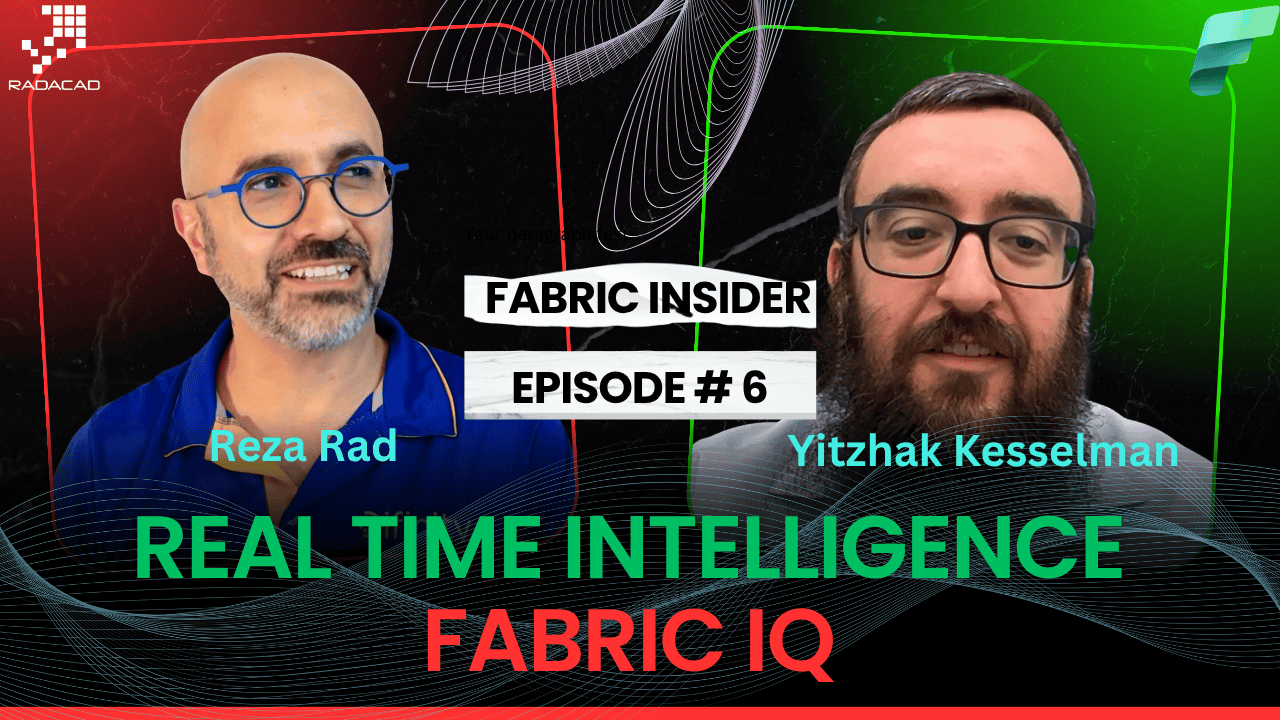
We had Fabric. Then Real-Time Intelligence. Now Fabric IQ.
What comes next?
That is the question I most wanted answered when I sat down with Yitzhak Kesselman — Corporate Vice President for Real-Time Intelligence at Microsoft Fabric. Yitzhak leads not only Fabric RTI and Fabric IQ but also the Microsoft observability products within Azure. This is one of the most expansive portfolios in the Microsoft data organisation — and it puts Yitzhak in a unique position to speak about both where the market is today and where it is heading.
This was also a return visit for Yitzhak, which made it particularly valuable — he had been watching how the community received his product updates, and he came back with a lot to say.
Let’s get into the conversation.
Fabric Insider Series | Episode 6 | Interview with Yitzhak Kesselman, Corporate Vice President for Real-Time Intelligence at Microsoft Fabric
📺 Watch the full episode on YouTube: Fabric Insider Ep. 6 — Real-Time Intelligence & Fabric IQ | Yitzhak Kesselman | Microsoft Fabric
🎧 Listen on Spotify: Fabric Insider Podcast
📚 Full Fabric Insider Blog Series: radacad.com/category/fabric-insider-2026
🎬 Full Fabric Insider Playlist: YouTube Playlist
🔗 Yitzhak Kesselman on LinkedIn: linkedin.com/in/yitzhak-kesselman
Who Is Yitzhak Kesselman? (Video: 0:00)
Reza: Thank you for joining us again for another episode of Fabric Insider. It’s great to have you here again this year — we have so many things to talk about, especially Real-Time Intelligence and Fabric IQ. How are you doing?
Yitzhak: Hey Reza, good. Thank you for having me again. It’s a pleasure to be on your channel.
Reza: Before we talk about all of these exciting things, can you please introduce yourself? What do you do in the Microsoft team? Which part of the product you are on?
Yitzhak: Yes, of course. My name is Yitzhak Kesselman. I lead the Fabric platform, Fabric Real-Time Intelligence, and Fabric IQ. I also lead the Microsoft observability products, part of Azure. So quite a portfolio — but excited day-to-day to help our customers achieve more with our products.
Reza: It is quite a big area, and no wonder you are doing so many travels around the world managing all of that.
What Is Real-Time Intelligence? (Video: 1:12)
Reza: Let’s start with Real-Time Intelligence — what that is from a business point of view, from someone who hasn’t worked with it before.
Yitzhak: So actually, we are catering for business users a lot. And when we speak about Real-Time Intelligence, it’s not about the seconds or the milliseconds of acting on data. You can think of it as acting in a timely manner. You can think of it as event-driven architecture. So let’s say for your business, if a certain event is happening — for example, a package is being delayed, or a new reservation comes in, or any event that happens in the business — you want to be able to analyse it, understand what it means, but then also to be able to act on it. And understand how these specific events impact the whole business holistically. That is what Real-Time Intelligence is all about: the ability to capture all those signals, understand them in the context of the rest of the data — the rest of the batch data in the system — and then also the ability to reason and act on top of all of it.
Reza: I like that explanation because there are so many explanations talking about real-time meaning you would have like instance response time. But that definition of making it event-driven is actually quite helpful.
💡 The key insight: Real-Time Intelligence is not about millisecond response times. It is about event-driven architecture — acting on data when specific business events happen, in the context of all your other data.
Which Businesses Benefit Most from RTI? (Video: 2:29)
Reza: Based on that — what type of businesses actually get benefit from Real-Time Intelligence?
Yitzhak: It is kind of one of my favourite slides — it is all of the above! But jokes aside, we are seeing it across the board. Of course, the traditional manufacturing scenarios, supply chain — they have a high importance of time. But it is across the board. Scenarios from healthcare, aviation, supply chain, automotive, services — you name it. All verticals of the industry today use Fabric Real-Time Intelligence in production. We have quite a few large customers using the product today.
And really the change in the market that we are seeing: we are seeing more and more customers moving beyond analytics. They understand their reporting, their standard analytics — but they want to use all the signals that the system now generates. Use those signals to power their business, but also to power AI. And that is a key part where we are seeing acceleration of this domain across the board.
Reza: I think this is important to look at from this point of view — because one of the misconceptions in the market is that real-time is needed for healthcare only or for aviation. For scenarios where you need instant response time. But based on what you are saying, any business in any industry can benefit from that — because you are working based on events instead of humans defining a process and running that process manually.
Why Real-Time Intelligence NOW? Why Not 20 Years Ago? (Video: 4:07)
This was one of the most honest and insightful parts of the conversation. The need for real-time data did not appear recently — businesses have wanted event-driven analytics for decades. So what changed?
Reza: This kind of event-driven system — we had that need for a long time. Businesses have been operating for many years. Why real-time NOW? Why not 20 years ago?
Yitzhak: I think the demand did not change. I speak a lot with business decision makers and people that own the businesses. They say: “I had this requirement from IT for 20 years or even more than that. But IT always told me: ‘Real-time? That’s super expensive. You don’t need it — wait 15 minutes, you’ll be fine.'” And that was the answer the business was getting.
But with advancements in technology and the solution that we built, it is very easy for everyone to consume it now. You do not need to have a very advanced IT team. The product is very easy to consume even for business users — and that is part of the goal. That is how we built it. To really enable and empower the business people who know the business, but are not advanced IT people, to be able to understand the signals, collect the signals, and act on them.
The technology underlying engines were available for more than 10-plus years. But a big part of Real-Time Intelligence is making sure that, because you collect a lot of signals, it does not become too expensive. That is a big part of why those engines are super powerful and super important. Microsoft runs on those engines. All the Microsoft observability products and Microsoft security products consume those engines — and they are very cost-effective, because you need to process a lot of data and that needs to be very cost-effective.
So that is one angle — the business always wanted it but the solution was not there.
But we are seeing another angle with our customers today. And that is a quote I heard from several CIOs across the world — in one day I heard it from two CIOs in Paris on the same day: “There is no AI without RTI.” There is no AI without Real-Time Intelligence. If I want to really enable the power of artificial intelligence, machine learning, or large language models — I want to have high-granularity data. I do not want to just aggregate the data. More than that, I need to have fresh data. Because if I am going to analyse data that is a day old, an hour old, or a week old — I am going to get the same answer. So I need always to have high-granularity and fresh data. And for that, it is critical to have a Real-Time Intelligence platform.
Reza: Correct. When you can have fresh data, why should you process it from a week ago?
What Makes Fabric RTI Unique? (Video: 6:54)
Reza: Talking about Fabric Real-Time Intelligence in general — we had real-time technologies 10 or 15 years ago. Microsoft had it. Other vendors have it. What is the unique value proposition that Fabric RTI provides?
Yitzhak: With Fabric Real-Time Intelligence, we put business users in our focus — not only data engineers and developers. Of course we cover them, and they have been covered by the previous offerings at the platform and PaaS services level. But we want to cater to the business users. People who want to take decisions, drive their business. They understand the data, they understand the business needs — but they did not have the right tools to do it themselves. That is what Fabric Real-Time Intelligence is helping them do.
We provide solutions out of the box where they can easily bring all this data in, process it in a way that caters to business decision makers — not just developers. Then they can decide, take an action. But we also include AI capabilities out of the box with Copilot, where they can really analyse, process, and find insights out of petabytes or terabytes of data easily.
And we empower them with agentic experiences where they can deploy autonomous agents — what we call operations agents — with Fabric Real-Time Intelligence to really run their business. They can easily create those agents that help them augment their team and find insights, but also take action on them.
Reza: And as a technical person I have to add — 15 years ago, if you wanted to set up a real-time streaming system, it was quite a lot of technical work. But with Fabric Real-Time Intelligence, with the agents, with how the UI is set up and how it is connected to all the back end — it is much simpler to set up. Even business users can do that as well.
If you want to understand all the components of Fabric Real-Time Intelligence — Eventstream, Eventhouse, KQL, Activator — I have a dedicated article covering all of these: Fabric Real-Time Analytics on RADACAD. And the Microsoft Fabric Glossary also covers all key RTI terms.
Is Traditional BI Dead? (Video: 8:50)
This is a question I know is on the mind of every Power BI developer in the audience. And Yitzhak was very clear about it.
Reza: One question that always comes up from people in the BI background — like myself — is: how does this transform BI? Is traditional BI dead? Is ETL dead? Is this the new way to do things? Or do you still see value in both?
Yitzhak: For the record — those that do not know me — I was on the team that built Power BI. I was leading mobile applications and also the Power BI service. So I am quite invested in this space. That is one of my first babies.
BI is not dead. BI is needed. You still need analytical understanding of your business. You still need analytical reports. There are reports that are still critical — for example, financial reports or legal reporting. For those, you do not need the same level of freshness or granularity. So you still need the analytical space.
But when you want to go beyond just the analytical — when you want to go to the operational — you need more than just analytics. You need the signals that are coming in at high granularity. When you want to empower your agents to reason about all your data, and not just the gold layer in the medallion, you want to make sure they are working with raw data. That is where you need Real-Time Intelligence. That is where you need Fabric IQ. When you want to go beyond analytical into the operational space.
Reza: Amazing. So it is not either/or. It is both. BI for the analytical. RTI for the operational.
Customer Success Stories (Video: 10:27)
Reza: Can you share one or two successful customer stories that have used Real-Time Intelligence?
Yitzhak: There are many. And one of the recent ones I would like to share with the audience comes from Australia — which is close to home for your audience, Reza.
The Australian Energy Market used Fabric Real-Time Intelligence — and the rest of the Fabric suite — to collect all the signals needed to understand how the grid is working. What is the demand. What is the supply. They use it to empower the decision makers, the people taking decisions on the grid, the people who need to understand and troubleshoot if something happens.
And they were able to reduce the time to operate and find insights from hours to seconds and minutes, depending on the case. This is a very big shift. Before, they had very complex and advanced systems that required a large IT team to build them. Now, the business people themselves find those insights in the product immediately. They deploy operations agents that understand what is happening and provide the right signals. And because they are working with the high-granularity event-based data, they were able to move into predictive maintenance and forecasting — done by the business people, not just IT.
Reza: That is amazing. And I will make sure we share some of the links to these customer stories in the description below.
Yitzhak: There are also examples across the globe. One more I want to mention is Valomar — a hospitality chain out of Europe. They used Fabric RTI to manage their call centres, understand incoming calls, reroute them, forecast staffing needs. And they use it in the hotels themselves — to provide better experiences to customers, to know when they check in, to use data about customers to provide better service.
And they were able to generate more than €20 million of new net revenue per year with Fabric Real-Time Intelligence. When I heard this at a Fabric conference, I turned to someone and said: “I know what their bill is — it is less than a thousand euros a month.”
Reza: Wow. That is an incredible return. And it goes back to the point you made earlier — RTI is not expensive. The solution is very cost-effective.
Myth vs. Reality: Does RTI Require High F SKUs? (Video: 13:09)
Reza: There is a misconception in the market — can you tell us: is it a myth or reality that you need a really high SKU to use Real-Time Intelligence? That people think with low F SKUs they cannot use it effectively?
Yitzhak: I will share the feedback I am getting from Microsoft sellers — they complain it is too cheap. That is the complaint I am getting. So definitely you can use F4 — not F2, but F4 — and you can easily build a solution. We have customers that build full production solutions on smaller SKUs.
And the Valomar story I just shared — a hospitality chain generating €20 million a year in new revenue — their Fabric bill is less than a thousand euros a month. So it is really a myth. The solution is very, very cost-effective. And yes, you can use lower SKUs. We have a lot of smaller customers that use it because it is so easy to use.
Reza: And I would also recommend everyone to try RTI. It is not just for higher SKUs. It is of course dependent on how much event load you are pushing through — but you can definitely use it with lower SKUs. And now let’s take the elephant in the room — Fabric IQ. Such big news. Let’s start with what it actually is.
💡 Myth busted: You do not need a high Fabric SKU to use Real-Time Intelligence effectively. F4 is sufficient for many production workloads. The smallest SKU capable of running RTI production solutions is F4 — not F64 or F128 as some assume.
What Is Fabric IQ? (Video: 15:46)
Yitzhak: So going back to an existing problem that many organisations have had for many years — especially in the era of AI.
Fabric consists of three layers. The first layer is OneLake — all the data. Our goal is really to empower humans and agents to work together, to be able to help run businesses, take decisions, and really work together to run the business.
To do so, they need context. There are different types of context. As an employee, I have access to my Outlook, my Teams, my company documents and policies — but I also have access to some operational systems: CRM, ERP, and other operational systems that help me do my work.
What we need to build is the same context for our agents. If we want agents to be as productive as humans, they need the same context. And they need that context not just to be as powerful, but to be grounded — to ensure the decisions they are making are grounded in the same context that we have as humans.
That is where Microsoft introduced the three layers — the Microsoft IQ stack:
- Work IQ — how the organisation and business operates. Who is my manager? Who are my team members? What documents do I have access to? What Teams chats am I working in? This is the organisational context.
- Foundry IQ — the documents, the operational procedures, all the unstructured data in the company that allows people to do their work.
- Fabric IQ — how the business operates. What are the different structured data sources, streaming data sources, what operational systems I have access to, and how I can use all this data to act on it.
Combining those three together, we generate this context for both humans and AI to run the business. Agents today are super powerful — every day there is a new LLM version, more powerful than the day before. But companies still do not see success with them, because even if agents can be as smart as they can — if they do not have the right context, they will not derive the right decisions. That is where the context of Microsoft IQ is critical.
Reza: So Fabric IQ is really the data and business context layer that the agents need to make good decisions — grounded in the actual operational data of the organisation.
Yitzhak: Exactly. And Fabric IQ consists of three layers itself:
- All the data in your organisation — streaming, batch, graph data — all in OneLake. You can bring all this data from on-premises, cloud, or other data platforms very easily.
- Semantic models — the analytical brain. Everyone is familiar with Power BI semantic models. There are more than 20 million of them in the world. They represent how organisations analyse and understand their business.
- Ontologies — the operational understanding that ties it all together. It has the data and analytical data, but it goes beyond that. It goes into the operational space. It has geospatial data, time series data, the ability to have actions on entities. And all those entities are interconnected by relationships that represent a business meaning — not just a foreign key. This relationship has a meaning. And then you can apply rules and actions to really model how your business operates.
Ontologies vs. Semantic Models — Will Ontologies Replace Semantic Models? (Video: 21:34)
Reza: Are we going to see more of ontology in the future as the layer on top of the semantic model? Because right now the semantic model is our main area for business logic. In the future — would ontology replace it?
Yitzhak: The idea of semantic models today is to represent your analytical understanding of the business. You create semantic models for reports that represent financial results or inventory, and use those reports to understand what decisions to take. When you speak about ontologies — it goes beyond analytical. You have representations of entities similar to entities from the semantic models — but you can enrich them.
So you can have the same measures and data from the semantic models. But those ontologies go beyond just the measures and properties from the semantic model. They also have geospatial data. For example, if you pick an entity of a package — it has a location. It has properties like what type of package. It can have time series data — for example, what is the temperature of the package if it is temperature-sensitive, like medication. Or what is the velocity if it is in motion.
And all those entities are rich entities. They are not just tables and schemas like we use today in the BI space. They are rich entities that you can perform actions on. For example, reroute a package, or assign a package to a different delivery. So you can start moving from the analytical space into the operational space.
That is what we want organisations to do — go beyond just analytics to also operate the business. Not just analyse it. Take action based on the data they have invested so many years in collecting.
Reza: I like that explanation. Without Fabric IQ — with my Power BI report, my Fabric Warehouse, my analytics — I analyse the data. But as a decision maker, I still have to go and act on it manually. There is no process that connects those two together. Whereas Fabric IQ connects the dots — so I can have an operational agent connect to that and, based on the data, have actions done automatically. Is that right?
Yitzhak: Yes. Exactly that. That is exactly the direction.
Fabric IQ Even If You Don’t Use RTI (Video: 25:02)
Reza: Even if businesses don’t use something like Real-Time Intelligence — they would still get benefit from Fabric IQ, right?
Yitzhak: Correct. Many organisations today want to start using AI. They have all the data and analytical data. But they need to create this context — they want to go beyond just speaking with your data, analysing the data. They want to start building agents that can take decisions, recommend actions, and start taking actions. Those agents need the right context. And for this context to be ready, they need to understand how a certain entity is connected to a different entity. What is the relationship between a package, a driver, a customer, and the sender?
You need to model it in a way that decisions are made holistically. Not locally optimised — “I want this package to deliver very fast.” Taking a local optimisation could have a very bad downstream effect. So you need to look at the business holistically. You need to create something that models your business — what I would call the operational brain of the business, both analytical and operational. And that is where we are seeing a lot of interest from organisations.
Reza: And that would enable organisations to scale up much faster — because there would not be a bottleneck of humans processing and analysing data and then going to act on it. We are connecting the links.
RTI and Fabric IQ in the Agentic Era — MCP Servers, APIs, and More (Video: 26:58)
Reza: Different tools, different vendors, are providing tools for AI applications and agents — MCP servers, APIs, Copilot skills. What is happening in the Fabric side, especially in Real-Time Intelligence?
Yitzhak: Everything that we do, we support MCP servers. There is a bunch of MCPs that Fabric exposes. You can use those MCPs to use the product even without the user interface. Go try it out — there are MCPs for RTI and for Fabric broadly.
We also expose skills that can be used in Fabric to really build, create, and start consuming the data and data products you build.
And actually — I had a conversation with a customer that is transforming their company to be an AI-native company. Meaning everything is powered, run, and decided by AI. And to build such a future — and I do not call it future, I call it present, because more and more companies are in this space — you need to make sure you have the right grounding and understanding. You need your data across your business. You need to be able to model your business holistically. That is what powers AI.
Even if you build your agents outside the Microsoft ecosystem — through other AI providers — you can use and consume all of this through MCP.
Reza: And I would recommend everyone who hasn’t used the Fabric MCP Server to go and try it. It is amazing what you can do with it. You can connect it with Claude, GitHub Copilot, or anything to get it working. I covered this in detail in our Fabric Insider Ep. 8 with Hasan Abo-Shally — a full episode dedicated to Fabric MCP Servers and the Fabric CLI.
Certifications and Learning Path (Video: 29:27)
Reza: For our audience who are either professionals in this area or want to become professionals in Real-Time Intelligence and Fabric IQ — what are the learning paths and certifications for them? We already have DP-700. Are there going to be more certifications?
Yitzhak: There is a ton of learning materials that we have. Learning paths, certifications — there is DP-700 that I highly recommend. It is comprehensive across all of Fabric. I also believe there is a new certification coming that will be around SQL and databases — DP-800.
But our goal here is really to make sure that everything we release is fully documented, and we even have learning paths that you can find before the certifications. You can use and try the product, and we have a very generous trial period — so you can use the product, try it, feel it yourself on your data, and really experience it. And if you have feedback, please share it with us. That is how we improve it — based on your feedback.
Reza: I will put those links down in the description below, plus I will add some extra links to Microsoft Learn so you can start your learning journey on RTI and IQ. You can also read my article on Microsoft Certification Exams for Power BI and Fabric for a full breakdown.
What Is Coming on the Roadmap? (Video: 31:09)
Reza: We have talked about a lot of things. What do you see on the roadmap coming for both RTI and IQ that you can share?
Yitzhak: On the IQ side, we are working very hard to GA the product soon — that is the focus of the team. We are providing the breadth and depth of the product needed to make it generally available.
One of the things that excites me personally is the work around an agent experience that helps customers build ontologies based on their data, metadata, and industry definitions easily. Today, one of the blockers for customers is how quickly they can build those ontologies. With this agent experience, it is going to really accelerate things and enable customers to go to the agentic space very quickly. There are also features around versioning, import, export — a lot of things working in the IQ space.
On Real-Time Intelligence — we are working on GA-ing Operations Agents, coming soon. That is something I am super excited about because it really empowers business users — people who understand the business, understand the data, but now want to take decisions, take actions, and have someone monitoring the data 24/7, finding insights and taking actions.
Across the board on Eventstream, we are adding more connectors. One thing I am excited about is the custom connector — enabling data professionals themselves to build a specific custom code connector for data providers that we do not support yet or that are very niche or unique.
And we are also making investments in the Eventhouse engine — making it more scalable and supporting more scenarios around real-time dashboards and insight exploration.
Reza: Amazing. And I have to mention to everyone watching — watch the Fabric blog closely, because almost every week you see an update about Real-Time Intelligence and IQ. Just today I was looking at the blog and found that in Eventstream, you can now have destinations for operational agents and for business events. So amazing. The pace of shipping is incredible.
The Vision: What Comes After IQ? (Video: 34:03)
Reza: Let’s take a step back. Microsoft started with Power BI, expanded to Fabric, then Fabric Real-Time Intelligence, and now Fabric IQ. What is your vision? What will this become in five years? Two years?
Yitzhak: I will be honest — it is very hard for me to predict as the pace is accelerating. What was 5 years from now today feels like 6 months.
But the work we are doing is really enabling AI transformation across the globe. We work with our customers to understand what is blocking them, what are the pain points, what is working and what is not. That is what guides us to build Fabric Real-Time Intelligence — the demand from the market said: “I want to act on the data, not just look at it.” And Fabric IQ came from customers saying: “We have those agents, but we want to make sure they are grounded on the context of the business, all the way through.”
One area that I am super passionate about — and I published an article about it a few days ago — is around memory and AI. I think today it is one of the pain points — how you use memory to really represent what context the agent should have. So I think it is an interesting area of upcoming investments in this space.
Reza: I have to read your article about memory and AI. That sounds really interesting. And I completely agree — the pace is so fast that predictions feel almost impossible to make.
How to Reach Yitzhak and Give Feedback (Video: 36:03)
Reza: How can our audience reach out to you or your team if they have feedback or want to share their customer story?
Yitzhak: First of all, feel free to reach out to me over LinkedIn. I am responsive — including if there are issues. We also have the Fabric Ideas site where you can provide feedback on the product — what is working, what is not working. You can also upload feature ideas. That is the place where the team is looking, reading the feedback, looking at the votes, and that helps us prioritise the backlog.
Reza: I will add the link to the Ideas website as well. One point about the Ideas website: do not just put your ideas there and leave them. Make sure others know about your idea. Promote it — so that it gets enough votes. The team has a limited number of resources, so they have to choose what to prioritise. The more votes, the higher the priority.
My Takeaway from This Conversation
Yitzhak made something very clear in this conversation: the distinction between analytical and operational is the most important conceptual line in the data platform right now. Power BI and Fabric have been about analytics for years. Fabric IQ is the bridge to operational.
A few things that stood out for me:
- The SKU myth is well and truly busted. €20 million in new revenue, built on a Fabric bill of less than €1,000 a month. The economics of RTI are more compelling than most people realise.
- Fabric IQ is not a product. It is the missing layer. Analytics tells you what happened. Fabric IQ — with ontologies, geospatial data, time series, actions, and interconnected business entities — gives agents the context to decide and act. That is a fundamentally different capability than a semantic model.
- The Microsoft IQ stack is a unique differentiator. Work IQ + Foundry IQ + Fabric IQ together create the full context that AI agents need to operate a business. No other vendor has all three layers natively integrated.
- Operations Agents is the next big thing to watch. Business users who understand the data but want to act on it 24/7 — without writing code, without IT involvement. That is the promise of Operations Agents. And it is coming soon.
Related Resources
- 📝 Fabric Real-Time Analytics on RADACAD
- 📝 What is Microsoft Fabric and Why It Is a Big Deal
- 📝 Microsoft Fabric Glossary
- 📝 Microsoft Certification Exams for Power BI and Fabric
- 📝 Where to Start Microsoft Fabric as a Power BI Developer
- 📝 Power BI Real-Time Streaming Dataset
- 💡 Fabric Ideas Site — Submit Your Feedback
- 💬 Microsoft Fabric Reddit Community
- 🔗 Yitzhak Kesselman on LinkedIn
Other Episodes in the Fabric Insider Series
- Fabric Insider Ep. 3 — Power Query, Dataflows and What’s Next with Miguel Escobar
- Fabric Insider Ep. 4 — Fabric Spark: Custom Live Pools, Resource Profiles & Performance Fixes with Santhosh Kumar Ravindran
- Fabric Insider Ep. 5 — What’s Hot and New for Power BI Semantic Models with Christian Wade
- Full Fabric Insider Series on RADACAD
- Fabric Insider Podcast on Spotify
- Full Fabric Insider YouTube Playlist
Reza Rad is a Microsoft Regional Director, Data Platform MVP, Author, and Trainer. He is the co-founder of RADACAD and the author of multiple books on Power BI, Power Query, and Microsoft Fabric. You can follow him on LinkedIn and subscribe to the RADACAD YouTube channel.


Reza is author of more than 14 books on Microsoft Business Intelligence, most of these books are published under Power BI category. Among these are books such as Power BI DAX Simplified, Pro Power BI Architecture, Power BI from Rookie to Rock Star, Power Query books series, Row-Level Security in Power BI and etc.
He is an International Speaker in Microsoft Ignite, Microsoft Business Applications Summit, Data Insight Summit, PASS Summit, SQL Saturday and SQL user groups. And He is a Microsoft Certified Trainer.
Reza’s passion is to help you find the best data solution, he is Data enthusiast.
His articles on different aspects of technologies, especially on MS BI, can be found on his blog: https://radacad.com/blog.